Online Pet Vet Pharmacy: Best Deals Up to 40% Off + FREE Shipping on Orders $100+

































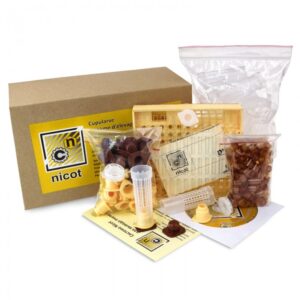
Beekeeping queen rearing system system set Nikot Milkman Nicot
$140.42
Nykot system to collect royal jelly special bowl shaped holders for tapes and tapes Nicot.
| ANIMALS | Bees |
|---|
Customers Also Viewed

Original price was: $21.82.$17.48Current price is: $17.48.
Original price was: $23.08.$20.90Current price is: $20.90.


Original price was: $26.28.$20.78Current price is: $20.78.
Description
Beekeeping queen rearing system
System Nikot (Nicot) set of “Milkman” (Milk) to collect royal jelly
Nikot system developed by experts in the field with all known biological needs of the modern science of beekeeping. Nicoplast French company during its existence has taken a leading position and recognition on products for bees. The company has more than 40 years (since 1973) and is constantly developing and modernizing its production equipment and manufactured products. Production for bee produced under the brand name Nicot ™.
All sets Nikot sets consist of components that can be purchased separately. This is especially useful for beekeepers, who first bought hundreds Nicot and when necessary be able to buy all the necessary components.
Set system Nykot “Milkman”
The world has appreciated the advantages of the use of royal jelly. Beekeepers to improve the profitability of the apiary looking for new sources of revenue. One of the new and very effective way is to get royal jelly.
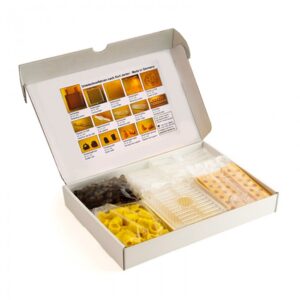
The system Nikot “Milkman” is a special bowls shaped strip 11 BOWLS. To install BOWLS on cell Nisot ribbons. The set of “milkman” of films – 10 pieces that fully satisfies the need for a system Nikot After receiving the tape transferred into royal family to further education. To set the bar for grafting in this set, the special holders for tapes or fastened using molten wax.
The complete set of system Nikot “Milkman” is
• Cell Nikot (cassette, the main cellular system any set Nicot) – 1pc.
• A set of tapes, BOWLS Nikot (each tape 11 BOWLS Nicot) – 10pc.
• Holders tape-BOWLS (to insert them tape-BOWLS larvae) – 5pcs.
• spoon for collecting MM (special spoon Nicot for royal jelly) – 10pc.
• user (originally delivered in French) – 1pc.
The set ” Milkman “no single BOWLS, holders and protective To display this set of females need to separately purchase necessary components of Nikot you.
Tapes, bowls larvae attached to the bracket holders vaccination or using melted wax. Wax – is quite simple and yet effective way to mount. Wax securely attaches bowls and bees are easy to take on royal upbringing. The use of holders Nikot enables significantly facilitate the transfer of larvae to vaccination bar.
The first use Nikotovskoyi system for removing the uterus or royal jelly, the beekeeper really appreciate the need (and size) of other components. All components if necessary you can buy in our online store Homelab Shop.
In the table below you can see the difference in trim kits Nikot.
If you have any questions regarding the assembly or use of Nikot (Nicot) – please contact us by phone or email. We are happy to answer your questions. Tel. +38 (096) 0417379.
Manufacturer: S.A.S. NICOTPLAST, Maisod, France (Nicot ™, Nikot France).
Delivery
We offer FREE SHIPPING WORLDWIDE for all products.
Questions & Answers
Questions and answers of the customers
Related products
-35% 
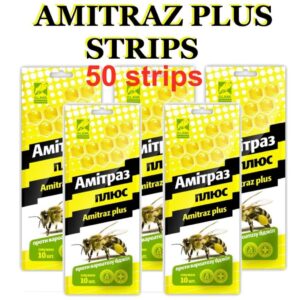
Amitraz Plus Strips Varroa Mite Treatment Honey Bee 50 Strips
Amitraz Strips
Honey bee colony treated in spring (after the first inspection of bee families) in the summer-autumn period (after pumping of honey) by placing preparation strips in beehives 2 strips on 10 – 12 nesting frames. For small bee colony (up to 6 frames) and nucleus boxes enough 1 strips that are placed in the center of the nest. Before using the need to do a hole at one end of the strip, stretch through it and lock pin stripes vertically exactly in the center beehive (in the middle part of it) between two frames of bee nests. In a weak honeybee colony hung one strip between 3 and 4 honeycombs, in strong – one strip between 3 and 4, and the second strip between 7 and 8 honeycombs. Strips leave in a honey-bee colony for a period of 3 to 30 days depending on the size of the brood.
-13% New Brand
FLUMETRIY treatment of varroatosis bees Varroa Beekeeper 50 Strips
Flumetriy Strips (flumetrin - 3.85 mg / pl, thymol - 80 mg / pl, juniper essential oil - 30 mg / pl, rosemary essential oil - 25 mg / pl, lavender essential oil - 25 mg / pl.)
Varroatosis treatment: Treatment of bee colonies affected by Varroa destructor mite or tracheal Acarapis woodi mite, Flumet-Roy preparation is carried out in spring, summer, and autumn. Treatment of bee families with the drug "Flumet-Roy" is carried out at the rate of 2 plates per 1 beekeeping force of 10 nest frames, with placement between 3-4 and 7-8 sotoramok, and 1 plate per beekeeping force of 5 nesting frames, with placement in the center of the socket. In case of severe tick damage, 1-2 strips of Flumet-Riy preparation for 10 weeks should be added.

-34%
Amitraz Plus Strips Varroa Mite Treatment Honey Bee 30 Strips
Amitraz Strips
Honey bee colony treated in spring (after the first inspection of bee families) in the summer-autumn period (after pumping of honey) by placing preparation strips in beehives 2 strips on 10 – 12 nesting frames. For small bee colony (up to 6 frames) and nucleus boxes enough 1 strips that are placed in the center of the nest. Before using the need to do a hole at one end of the strip, stretch through it and lock pin stripes vertically exactly in the center beehive (in the middle part of it) between two frames of bee nests. In a weak honeybee colony hung one strip between 3 and 4 honeycombs, in strong – one strip between 3 and 4, and the second strip between 7 and 8 honeycombs. Strips leave in a honey-bee colony for a period of 3 to 30 days depending on the size of the brood.

-11% Sold out Taktik
-16%
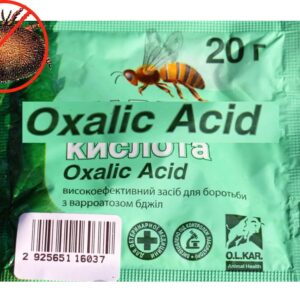
OXALIC ACID Pure Powder For The Treatment Of VARROATOSIS of BEES (100g 50doses)
OXALIC ACID
A specially prepared solution of oxalic acid is used to treat the hives' interframe space. This is necessary for disinfection, getting rid of parasites (specific mites), preventing the appearance of mold, pathogens. A 2% solution of oxalic acid is used. For cooking you need:
the water is warm, boiled - 1 l;
oxalic acid powder - 20 g.
Consumption: 5-10 ml of solution for each interframe space. The frequency of treatment: three times in the spring, with an interval of a week, and also in the fall, when honey is collected, and the temperature is not lower than + 15ºC.