Online Pet Vet Pharmacy: Best Deals Up to 40% Off + FREE Shipping on Orders $100+































-4% New ceftriaxoneRocephin (ceftriaxone)


Cysta Cur for dogs and cats urinary tract powder 30 tablets
Original price was: $60.50.$51.70Current price is: $51.70.
Prosed Solution for Dogs, Cats, Horses 10 ml
Original price was: $65.66.$59.74Current price is: $59.74.
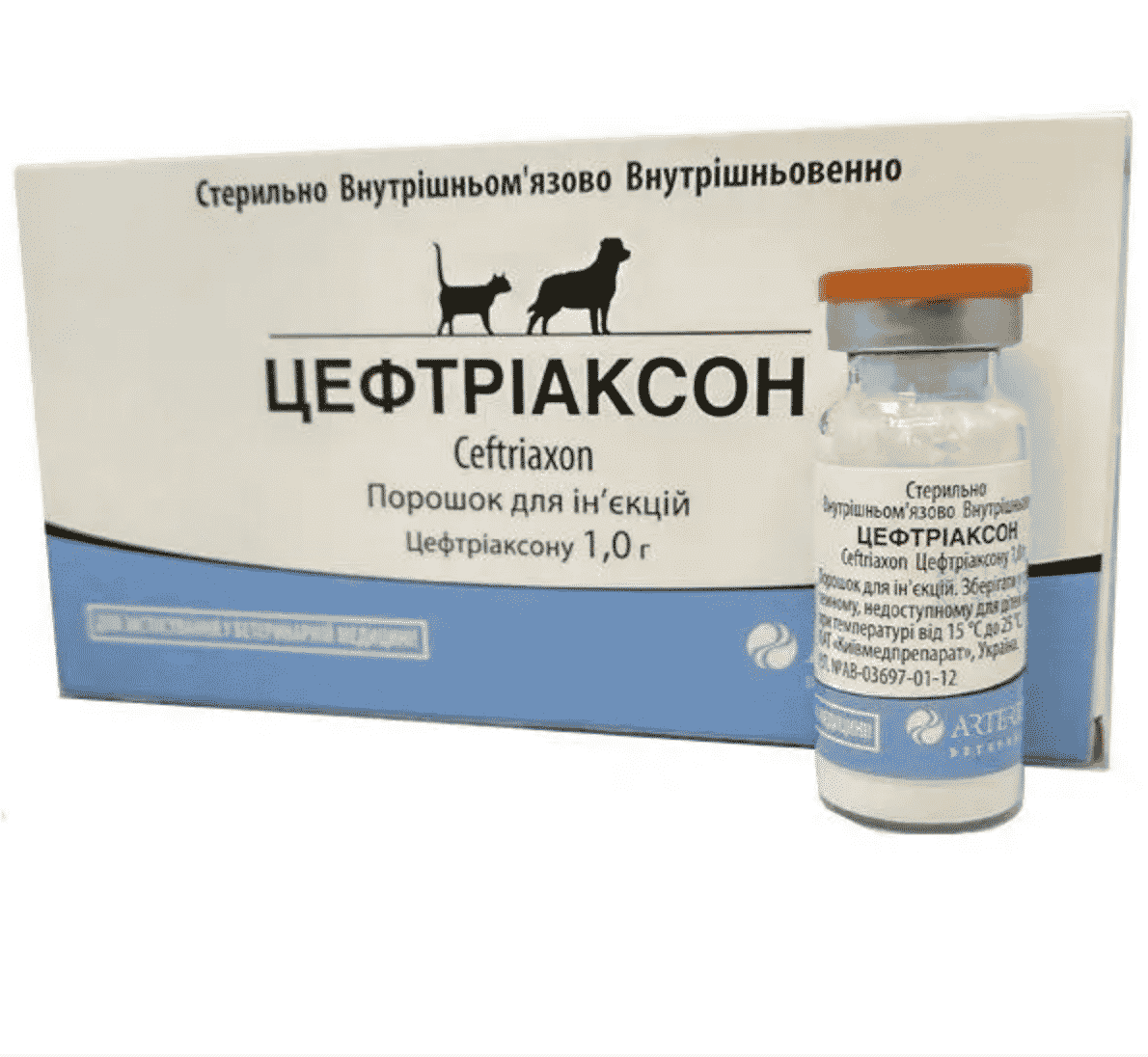
Ceftriax powder for *inj (5 vials)
Original price was: $27.49.$26.28Current price is: $26.28.
| ACTIVE INGREDIENT | ceftriaxone, Rocephin (ceftriaxone) |
|---|---|
| ANIMALS | Cats, Dogs |
| HEALTH CONDITION | Antibiotics |
| BRAND | Arterium, Basalt |
| FORM | Powder ❙ Granules |
Customers Also Viewed

Original price was: $39.59.$33.98Current price is: $33.98.
Original price was: $38.49.$36.18Current price is: $36.18.

Original price was: $42.72.$37.84Current price is: $37.84.
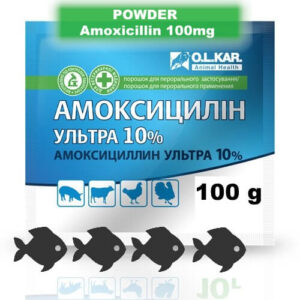
Original price was: $28.59.$25.07Current price is: $25.07.
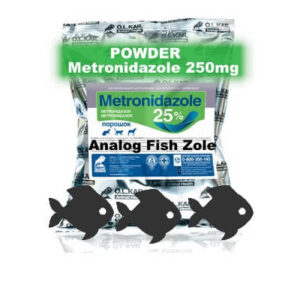
Original price was: $31.89.$27.27Current price is: $27.27.
Description
Ceftriax (ceftriaxone) powder for injected (5 vials/1g)
Active ingredient: ceftriaxone
Release form: Powder for injections
Description
Crystalline powder of white or yellowish color. Weakly hygroscopic.
Compound
5 vials contain the active ingredient:
ceftriaxone sodium salt sterile in terms of ceftriaxone – 1.0 g. each vial
Pharmacological properties
Ceftriaxone is a third-generation cephalosporin antibiotic for parenteral administration with a wide spectrum of antimicrobial activity, high activity (especially in infections caused by penicillinase-producing microorganisms) and prolonged action. It has a bactericidal effect by inhibiting the synthesis of the bacterial cell wall. Ceftriaxone acetylates membrane-bound ¢ linked transpeptidases, thus disrupting peptidoglycan cross-linking, which is essential for cell wall strength and rigidity. Ceftriaxone is active against gram-positive aerobic bacteria: Staphylococcus aureus (including penicillinase-producing strains), Staphylococcus epidermidis, Streptococcus pneumoniae, Streptococcus pyogenes, Streptococcus viridans; gram-negative aerobic: Enterobacteraerogenes, Enterobacter cloacae, Escherichia salts, Haemorhilus influenzae, Haemorhilus parainfluenzae, Klebsiella spp. (Including K. pneumoniae), Moraxella catarrhalis, Morganella morganii, Neisseria gonorrhoeae, N. meningitidis, Proteus mirabilis, Proteus vulgaris, Serratia spp. (Including Serratia marcessens), Acinetobacter calcoaceticus; Peptostreptococcus spp., Basteroides fragilis, Clostridium spp. (Except Clostridium difficile), Pseudomonas aeruginosa. It has in vitro activity against most strains of such microorganisms: Providencia spp., Basteroides bivius, Basteroides melaninogenicus, Salmonella spp. (Including Salmonella turhi), Shigella spp., Streptococcus agalactiae, Providencia rettgeri, Citrobacter freundii. Neisseria gonorrhoeae, N. meningitidis, Proteus mirabilis, Proteus vulgaris, Serratia spp. (Including Serratia marcessens), Acinetobacter calcoaceticus; Peptostreptococcus spp., Basteroides fragilis, Clostridium spp. (Except Clostridium difficile), Pseudomonas aeruginosa. It has in vitro activity against most strains of such microorganisms: Providencia spp., Basteroides bivius, Basteroides melaninogenicus, Salmonella spp. (Including Salmonella turhi), Shigella spp., Streptococcus agalactiae, Providencia rettgeri, Citrobacter freundii. Neisseria gonorrhoeae, N. meningitidis, Proteus mirabilis, Proteus vulgaris, Serratia spp. (Including Serratia marcessens), Acinetobacter calcoaceticus; Peptostreptococcus spp., Basteroides fragilis, Clostridium spp. (Except Clostridium difficile), Pseudomonas aeruginosa. It has in vitro activity against most strains of such microorganisms: Providencia spp., Basteroides bivius, Basteroides melaninogenicus, Salmonella spp. (Including Salmonella turhi), Shigella spp., Streptococcus agalactiae, Providencia rettgeri, Citrobacter freundii. It has in vitro activity against most strains of such microorganisms: Providencia spp., Basteroides bivius, Basteroides melaninogenicus, Salmonella spp. (Including Salmonella turhi), Shigella spp., Streptococcus agalactiae, Providencia rettgeri, Citrobacter freundii. It has in vitro activity against most strains of such microorganisms: Providencia spp., Basteroides bivius, Basteroides melaninogenicus, Salmonella spp. (Including Salmonella turhi), Shigella spp., Streptococcus agalactiae, Providencia rettgeri, Citrobacter freundii.
Application
Treatment of dogs and cats with otitis, sepsis, meningitis, as well as diseases of the respiratory and genitourinary system, skin and soft tissues, bones caused by microorganisms sensitive to ceftriaxone. It is used to prevent postoperative complications.
Dosage
For administration to dogs, the contents of one vial are dissolved in 3.6 ml of a 1% lidocaine solution or 0.25% – 0.5% novocaine solution, or in 3.6 ml of sterile water for injection. 1 ml of the solution thus prepared contains about 250 mg of ceftriaxone for a 1.0 g vial.
For administration to cats, the contents of one vial are dissolved in 3.6 ml of a 0.25% -0.5% novocaine solution or 3.6 ml of sterile water for injection. When used in cats, do not dilute the drug with lidocaine. 1 ml of the solution thus prepared contains about 250 mg of ceftriaxone for a 1.0 g vial.
For jet administration, the contents of the vial are dissolved in 9.6 ml of sterile water for injection or 0.9% sodium chloride solution, or 5% glucose solution. 1 ml of the solution thus prepared contains about 100 mg of ceftriaxone for a 1.0 g vial.
For intravenous drip, the contents of the vial are dissolved in 100-250 ml of 0.9% sodium chloride solution, or 5% glucose solution. The injection is carried out within 20-30 minutes (injection rate 60-80 drops per 1 minute).
The daily dose is 20-40 mg of ceftriaxone per 1 kg of body weight. If necessary, the frequency of use can be increased up to 2 times a day with a dosage of 10-20 mg of ceftriaxone per 1 kg of body weight. The drug is used from 5 to 10 days, depending on the form and severity of the disease.
*Kilograms to a Pounds conversion table
| Kilograms (kg) | Pounds (lb) | Pounds+Ounces (lb+oz) |
| 0.1 kg | 0.220 lb | 0 lb 3.527 oz |
| 1 kg | 2.205 lb | 2 lb 3.274 oz |
| 5 kg | 11.023 lb | 11 lb 0.370 oz |
| 10 kg | 22.046 lb | 22 lb 0.740 oz |
Contraindications
Hypersensitivity to a group of cephalosporins and other b-lactam antibiotics.
Do not administer to animals with renal or hepatic insufficiency. Do not administer to animals during pregnancy.
Warning
Gallbladder stones may form when dogs are treated with high doses of ceftriaxone. In the case of hypersensitivity to lidocaine, it is not recommended to use its 1% solution as a solvent.
Delivery
We offer FREE SHIPPING WORLDWIDE for all products.
Questions & Answers (1)
Questions and answers of the customers
-
A For administration to dogs, the contents of one vial are dissolved in 3.6 ml of a 1% lidocaine solution or 0.25% – 0.5% novocaine solution, or in 3.6 ml of sterile water for injection. 1 ml of the solution thus prepared contains about 250 mg of ceftriaxone for a 1.0 g vial. For administration to cats, the contents of one vial are dissolved in 3.6 ml of a 0.25% -0.5% novocaine solution or 3.6 ml of sterile water for injection. When used in cats, do not dilute the drug with lidocaine. 1 ml of the solution thus prepared contains about 250 mg of ceftriaxone for a 1.0 g vial. For jet administration, the contents of the vial are dissolved in 9.6 ml of sterile water for injection or 0.9% sodium chloride solution, or 5% glucose solution. 1 ml of the solution thus prepared contains about 100 mg of ceftriaxone for a 1.0 g vial. For intravenous drip, the contents of the vial are dissolved in 100-250 ml of 0.9% sodium chloride solution, or 5% glucose solution. The injection is carried out within 20-30 minutes (injection rate 60-80 drops per 1 minute). The daily dose is 20-40 mg of ceftriaxone per 1 kg of body weight. If necessary, the frequency of use can be increased up to 2 times a day with a dosage of 10-20 mg of ceftriaxone per 1 kg of body weight. The drug is used from 5 to 10 days, depending on the form and severity of the disease.
You may also like…
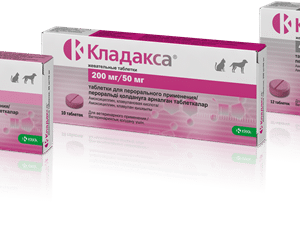
-20% Hot New AmoxicillinClavulanic acid
50mg (10 tablets)
250mg (10 tablets)
500mg (12 tablets)
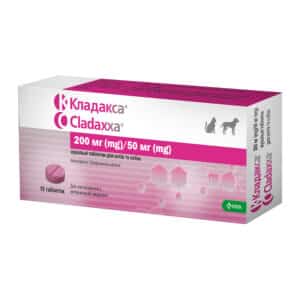
Cladaxxa, Synulox 50-500 mg for dogs and cats 10 tablets
Sinulox 250 mg / 50 mg ( amoxicillin + Clavulanic Acid ) analog Clavacillin, Clavamox, Clavaseptin, Betacillin
Treatment of a range of bacterial infections, including skin disease, soft tissue infections...
Prescribed to dogs and cats for the treatment of infections of bacterial etiology: diseases of the skin and soft tissues (abscesses, pyoderma, inflammation of the paranoid glands, gingivitis, stomatitis, etc.), respiratory diseases, diseases of the genitourinary system and enteritis.
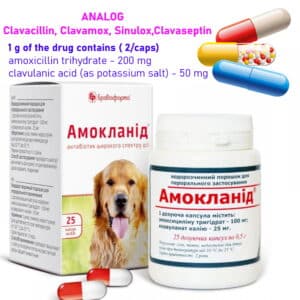
-14% AmoxicillinClavulanic acid
AMOK-CAPS for dogs, cats – 25 capsules
AMOK-CAPS (amoxicillin trihydrate - 200 mg, clavulanic acid (as potassium salt) - 50 mg)
Amoxicillin trihydrate - semi-synthetic penicillin, belongs to beta-lactam antibiotics, inhibits the synthesis of bacterial cell walls by inhibiting transpeptidase and carboxypeptidase, which causes a violation of osmotic pressure and the death of microorganisms in the developmental stage.
Potassium clavulanate is a beta-lactam structurally related to penicillins, has little antibacterial activity, but, irreversibly inhibiting a size of beta-lactamases, prevents inactivation of amoxicillin and provides its antibiotic activity against bacteria, usually resistant to other amoxicillin-resistant amoxicillin.

-25% New AmoxicillinClavulanic acid
Related products
-13% Tylosin
TYCLOSIN 500 mg/g Soluble Powder for poultry, chickens, pigs and dogs 25g
Tylosin (Tylan powder) 500mg for chickens ● poultry ● pigs ● dogs
Tylosin is an antibiotic typically used to treat bacterial infections in farm animals, but veterinarians often use it to treat certain types of chronic diarrhea in cats and dogs. The powder form is not FDA approved for use in companion animals, but it is common practice for veterinarians to prescribe this medication. The drug is also given as an injectable type.
It is prescribed for the prevention and treatment of respiratory mycoplasmosis of birds, infectious sinusitis of turkeys, as well as the treatment of dysentery and gastroenterocolitis of bacterial etiology of pigs, bronchopneumonia of calves caused by pathogens sensitive to tylosin. To combat necrobacteriosis in cattle and small ruminants.

-6% Tylosin
TYCLOSIN 500 mg/g Soluble Powder for dogs, chickens and pigs (100g/0.22lbs)
Tylosin (Tylan powder) 500 mg for chickens ● poultry ● pigs ● dogs
Tylosin is an antibiotic typically used to treat bacterial infections in farm animals, but veterinarians often use it to treat certain types of chronic diarrhea in cats and dogs. The powder form is not FDA approved for use in companion animals, but it is common practice for veterinarians to prescribe this medication. The drug is also given as an injectable type.
It is prescribed for the prevention and treatment of respiratory mycoplasmosis of birds, infectious sinusitis of turkeys, as well as the treatment of dysentery and gastroenterocolitis of bacterial etiology of pigs, bronchopneumonia of calves caused by pathogens sensitive to tylosin. To combat necrobacteriosis in cattle and small ruminants.
-9% Enrofloxacin
-16% New Tylosin
-7% Tylosin
TYCLOSIN 500 powder (50g) for Broiler chickens, Poultry, Pig, Dog
Tyclosin (Tylan Tylosin powder) 50% for dogs✔ for chickens✔ for cats✔
Tylosin is an antibiotic typically used to treat bacterial infections in farm animals, but veterinarians often use it to treat certain types of chronic diarrhea in cats and dogs. The powder form is not FDA approved for use in companion animals, but it is common practice for veterinarians to prescribe this medication. The drug is also given as an injectable type.
Tylosin – the drug of a wide spectrum bacteriostatic action.
Active ingredient tylosin tartrate 500 mg is a mixture of macrolide antibiotics produced by a strain of Streptomyces fradiae, comprising mainly tylosin A.
For: Chickens, Turkeys, Swine, Honey Bees, and occasionally can be prescribed to dogs and cats
-14% Oxytetracycline
-7% Tylosin

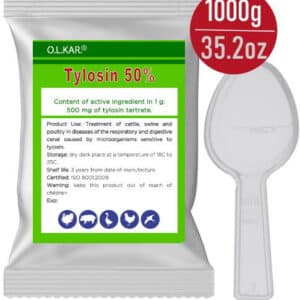
Tyсlosin 50% POWDER for pigs, poultry and chickens (1KG)
Tylosin (Tylan) Soluble powder for dogs✔ for chickens✔ for cats✔
Tylosin is effective against gram-positive and some gram-negative microorganisms: Corynebacterium spp., Clostridium spp., Erysipelothrix spp., Pasteurella spp., Vibrio spp., Leptospira spp., Brucella spp., Neisseria spp., Haemophilus spp... And against rickettsiae (Rickettsia spp.), spirochetes (Spirochaeta (Borrelia anserina, Brachyspira hyodysenteriae)), and mycoplasmas (M. gallisepticum, M. synoviae, M. meleagridis, etc..). In other words, tylosin exhibits bacteriostatic effect by inhibition of protein synthesis (via the irreversible connection with bacterial 50S ribosomal subunits) and microbial cell growth and reproduction, respectively.
-5% Tylosin
TYCLOSIN 500mg / 50% powder for poultry, chickens and pigs (500g)
Tylosin (Tylan powder) 500mg for dogs✔ for chickens✔ for cats✔
Tylosin is an antibiotic typically used to treat bacterial infections in farm animals, but veterinarians often use it to treat certain types of chronic diarrhea in cats and dogs. The powder form is not FDA approved for use in companion animals, but it is common practice for veterinarians to prescribe this medication. The drug is also given as an injectable type.
Tylosin – the drug of a wide spectrum bacteriostatic action.
Active ingredient tylosin tartrate 500 mg is a mixture of macrolide antibiotics produced by a strain of Streptomyces fradiae, comprising mainly tylosin A.
For: Chickens, Turkeys, Swine, Honey Bees, and occasionally can be prescribed to dogs and cats