Online Pet Vet Pharmacy: Best Deals Up to 40% Off + FREE Shipping on Orders $100+






























-10% Sold out 

Ftorfem powder for Pigs and Fish (carp and trout) 1000g
Original price was: $96.57.$87.77Current price is: $87.77.

Taktic Amitraz - 25ml
Original price was: $36.95.$33.44Current price is: $33.44.
Ftorfem 10 for farm animals *oral (100ml)
Original price was: $34.52.$31.24Current price is: $31.24.
Ftorfen (Florfenicol) 10% ORAL (Florcon analog)
– for the treatment of poultry colisepticaemia, pasteurellosis, respiratory diseases of bacterial etiology in birds, including those caused by Ornitobacterium rhinotracheaie, staphyllococcosis and other infectious diseases caused by microorganisms sensitive to florfenicol and secondary bacterial infections;
– for the treatment of pigs with respiratory diseases of bacterial etiology: pleuropneumoniae caused by Actinobacillus pleuropneumoniae and/or Haemophilus parasuis, atrophic rhinitis caused by Pasteurella multocida, Bordetella bronchiseptica, and other infectious diseases of pigs of bacterial etiology caused by florfenicol-sensitive microorganisms and secondary bacterial infections.
The drug is used orally with drinking water:
– for chickens aged up to 4 weeks – in a daily dose of 20 mg of florfenicol per 2.2lb (1 kg) of animal weight, which corresponds to 100 ml of the preparation per 100 liters of water;
– other age categories of poultry – 200 ml of the preparation per 100 liters of water for 3 days, and in salmonellosis – for 5 days;
– pigs orally with drinking water in daily dose of 5 mg of florfenicol per 2.2lb (1 kg) of live weight of the animal (which corresponds to 5 ml of preparation per 100 kg of live weight of the animal) during 7 days.
| ACTIVE INGREDIENT | Florfenicol |
|---|---|
| HEALTH CONDITION | Antibiotics |
| BRAND | O.L.KAR |
| ANIMALS | Broiler chickens, Fish, Pigs, Poultry |
| FORM | Suspension ❙ Emulsion ❙ Liquid |
| SIZE | 100ml (3.38 oz) |
Out of stock
Description
Florfenicol 10% ORAL (Florcon analog) Antimicrobial
Pigs, poultry pleuropneumonia, colisepticemia, pasteurellosis, staphyllococcosis, respiratory diseases of bacterial etiolog
Transparent solution.
Composition
1 ml of the preparation contains
active ingredient: Florfenicol 100 mg.
Pharmacological properties:
Fluorinated phenycol is a derivative of thiamphenicol, in which the hydroxyl group is replaced by the fluorine atom, causing its antibacterial activity against acetyltransferasosynthesizing bacteria, which are sensitive to chloramphenicol.
It is a bacteriostatic synthetic drug with a broad spectrum of action.
Florfenicol inhibits protein synthesis in bacterial cells. In protoplasm, it binds to 70S-ribosomal subunits, in which the enzymatic activity of peptidyl transferase is reduced, and thus slows down protein synthesis in ribosomes of corresponding bacteria.
Florfenicol acts against Gram-positive and Gram-negative bacteria, namely Escherichia coli, Pasteurelia multocida, Salmonella spp., Haemo¬philus spp., Proteus spp.., Staphylococcus spp., Streptococcus spp., Shigella spp., Klebsiella spp., Enterobacter spp., Actinobacillus pleuropneumoniae, Bordetella bronchiseptica, Mycoplasma hyopneumoniae, Mycoplasma hyorhinis, Salmonella cholerae suis, Streptococcus suis and others.
Application:
– for the treatment of poultry colisepticaemia, pasteurellosis, respiratory diseases of bacterial etiology in birds, including those caused by Ornitobacterium rhinotracheaie, staphyllococcosis and other infectious diseases caused by microorganisms sensitive to florfenicol and secondary bacterial infections;
– for the treatment of pigs with respiratory diseases of bacterial etiology: pleuropneumoniae caused by Actinobacillus pleuropneumoniae and/or Haemophilus parasuis, atrophic rhinitis caused by Pasteurella multocida, Bordetella bronchiseptica, and other infectious diseases of pigs of bacterial etiology caused by florfenicol-sensitive microorganisms and secondary bacterial infections.
The drug is used orally with drinking water:
– for chickens aged up to 4 weeks – in a daily dose of 20 mg of florfenicol per 2.2lb (1 kg) of animal weight, which corresponds to 100 ml of the preparation per 100 liters of water;
– other age categories of poultry – 200 ml of the preparation per 100 liters of water for 3 days, and in salmonellosis – for 5 days;
– pigs orally with drinking water in daily dose of 5 mg of florfenicol per 2.2lb (1 kg) of live weight of the animal (which corresponds to 5 ml of preparation per 100 kg of live weight of the animal) during 7 days.
During the treatment period, animals should receive only water containing florphenicol.
When this is not possible, the daily dose is divided into two equal parts and set at 12 hours intervals.
SIDE EFFECT:
It is not allowed to use the drug simultaneously with thiamphenicol or chloramphenicol, antibiotics of penicillins group, cephalosporins, fluoroquinolones due to possible occurrence of side effects and complications in animals.
CONTRAINDICATIONS:
It is forbidden to use the drug in sows whose egg is used for food purposes. It is forbidden to use the egg for animals that are hypersensitive to the drug, as well as for animals with severe renal and hepatic failure.
SPECIAL INDICATIONS:
It is allowed to slaughter pigs for meat in 14 days, poultry – not earlier than 6 days after the last application of the preparation.
In case of forced slaughter of animals before the established term, the meat is used for feeding carnivorous animals.
Storage:
Dry dark place, inaccessible for children at temperature from 41-86F (+ 5 ° C to + 30 ° C);
after opening at a temperature between 41-77F (+ 5 ° C to + 25 ° C).
Shelf life – 2 years from the date of manufacture.
Shelf life after opening the package – 28 days.
Delivery
We offer FREE SHIPPING WORLDWIDE for all products.
Questions & Answers
Questions and answers of the customers
Related products



-13% Hot New 

Tyclosin 50 mg Pharmastar Sterile Solution *inj 50ml (1.7 oz)
- An antibiotic for beef cattle, non-lactating dairy cattle and swine only
- Recommended for use in calves weighing less than 200 pounds
- Administered intramuscularly for quick relief
- Treats pneumonia (shipping fever), foot rot, diphtheria and metritis in cattle
- Treats arthritis, pneumonia, erysipelas and dysentery in swine
-12%
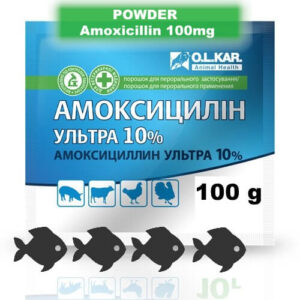
Amox 10% powder useful to control of some common bacterial fish and animals 100g
Amoxicillin Ultra 10% Powder
Treatment of calves (under 3 months), pigs and poultry (chickens, broilers, replacement chicks birds) in diseases of the digestive tract, respiratory and urinary tract, skin and soft tissue caused by microorganisms sensitive to amoxicillin.
Dosage Oral doses of calves up to 3 months and pigs -1-2 g product per 10 kg of body weight per day up or 7-15 g product per 10 liters of drinking water per day up within 5-7 days; poultry (chicken, chickens, young birds repair) – 0.5 – 1 g drug per 10 kg of body weight per day up or 5-10 g product per 10 liters of drinking water per day up within 5-7 days. Renew the water with the drug should be every 24 hours.
-16%
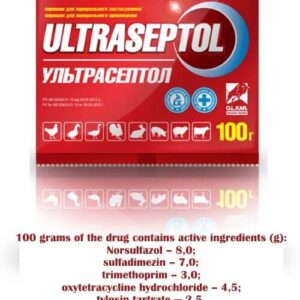
Ultrasept powder for Cattle, Pigs, Sheeps, Poultry 500 g
Ultrasept powder (sulfadimine, oxytetracycline, trimethoprim, tylosin, norsulfazole)
For the prevention and treatment of animals and poultry with primary and secondary bacterial infections of the respiratory, digestive and urinary tracts that is: the upper respiratory tract catarrh, pneumonia, enteritis, cystitis, mastitis, septicemia, postnatal complications, and a size of specific infections:
– Calves – Salmonella gastroenteritis kolibatselyarny, pasteurellosis, vibriosis;
– Pigs – enzootic pneumonia, arthritis, dysentery, edematous disease erysipelas, salmonellosis, pasteurellosis;
– Sheep – septicemia, eymerioz, contagious agalactia;
– Poultry – typhoid, cholera, salmonellosis, mycoplasmosis, rhinitis.

-11% Sold out
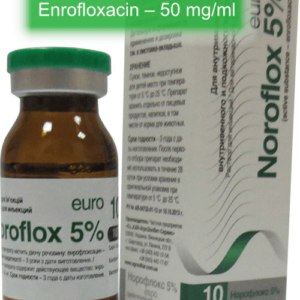
Noroflox 5% Solution for Cattle and Pigs (10ml)
Noroflox 5% injection (Enrofloxacin)
The active ingredient of the drug – enrofloxacin, belongs to the fluoroquinolone group of antibiotics and has a broad spectrum of activity against gram-positive and gram-negative bacteria. Its mechanism of action is based on the inhibition of bacterial gyrase enzyme, leading to disruption of bacterial DNA replication.
After parenteral administration of enrofloxacin rapidly and completely absorbed due to high bioavailability. Its maximum concentration is reached after an average of 6 hours. Therapeutic concentration is maintained within 2 days. Enrofloxacin partially metabolized in the liver and excreted in the urine and bile.
Enrofloxacin has a high level of distribution. Thus, the concentration in the tissues and organs is usually higher than in serum. The bodies, which can be observed the highest concentration – the lungs, liver, kidneys, intestines.

-5% 
TYCLOSIN 500mg / 50% powder for poultry, chickens and pigs (500g)
Tylosin (Tylan powder) 500mg for dogs✔ for chickens✔ for cats✔
Tylosin is an antibiotic typically used to treat bacterial infections in farm animals, but veterinarians often use it to treat certain types of chronic diarrhea in cats and dogs. The powder form is not FDA approved for use in companion animals, but it is common practice for veterinarians to prescribe this medication. The drug is also given as an injectable type.
Tylosin – the drug of a wide spectrum bacteriostatic action.
Active ingredient tylosin tartrate 500 mg is a mixture of macrolide antibiotics produced by a strain of Streptomyces fradiae, comprising mainly tylosin A.
For: Chickens, Turkeys, Swine, Honey Bees, and occasionally can be prescribed to dogs and cats