Online Pet Vet Pharmacy: Best Deals Up to 40% Off + FREE Shipping on Orders $100+


































-20% New Eprinomectin Antiparasitic
Antiparasitic
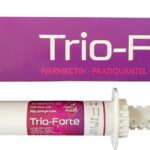
TRIO-FORTE Gel Horse Wormer 60 ml (30ml*2pcs)
Original price was: $65.00.$46.00Current price is: $46.00.
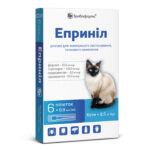
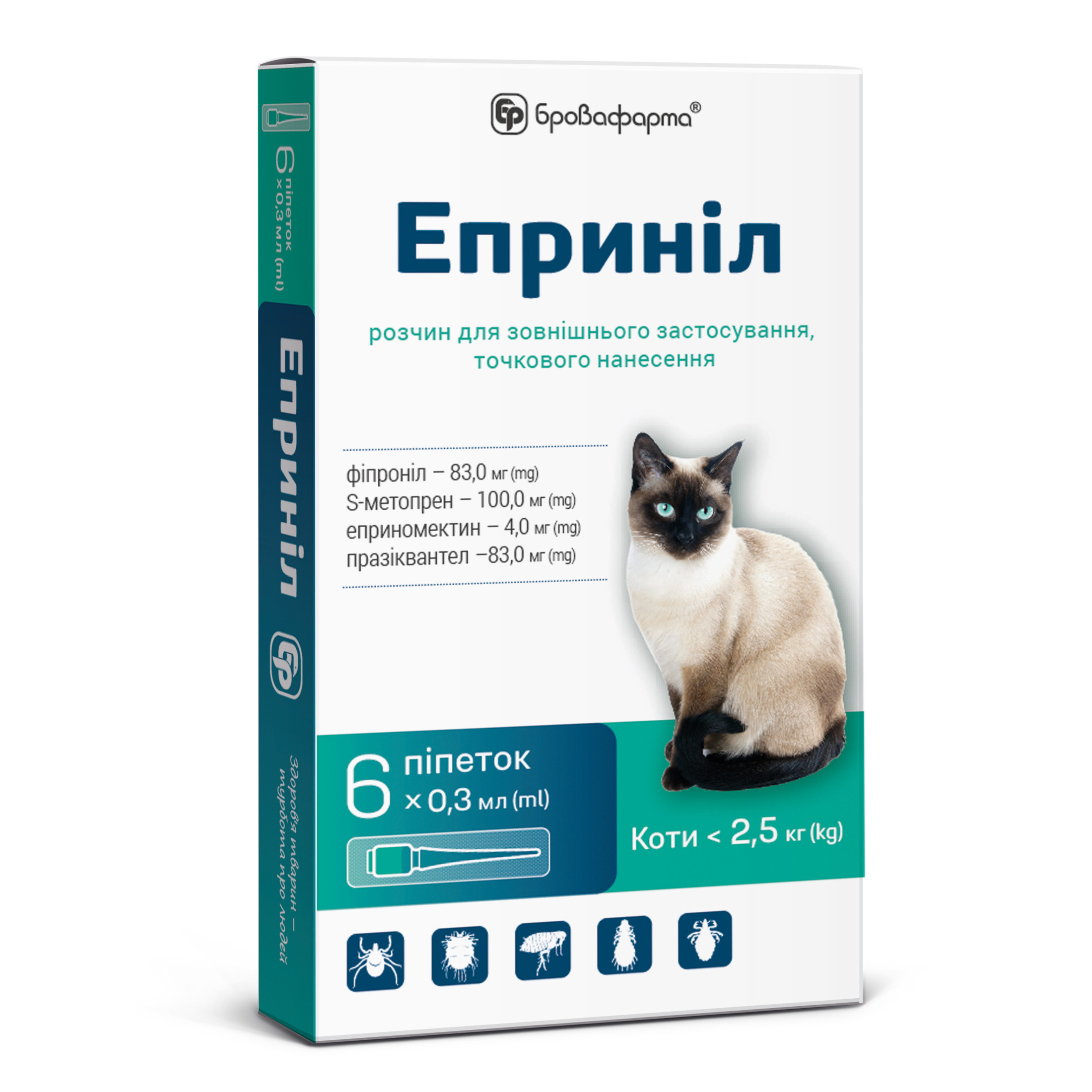
EPRYM antiparasitic solution for small Cats 0,9ml x 6 pipettes
Original price was: $55.00.$39.80Current price is: $39.80.
EPRYM antiparasitic solution for small Cats 0,3ml x 6 pipettes
Original price was: $45.00.$35.90Current price is: $35.90.
| ACTIVE INGREDIENT | Eprinomectin |
|---|---|
| HEALTH CONDITION | Anthelminthics, Antiparasitic |
| ANIMALS | Cats |
| BRAND | Brovafarma |
| FORM | Solution |
| SIZE | 0,3 ml x 6 pipettes |
Customers Also Viewed
Original price was: $32.43.$29.58Current price is: $29.58.
Original price was: $35.19.$32.88Current price is: $32.88.
Original price was: $29.69.$25.18Current price is: $25.18.
Original price was: $30.79.$27.38Current price is: $27.38.
Description
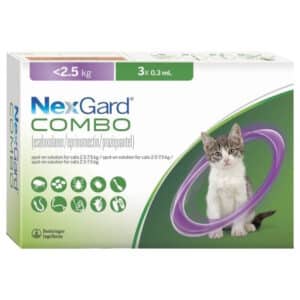
Eprinomectin antiparasitic solution solution for external use, 0,3 ml 6 pipettes
1 pipette for cats below 2,5 kg bodyweight
Description
The solution is colorless or light brown, transparent.
Composition
1 ml contains:
fipronil – 83 mg
S-methoprene – 100 mg
eprinomectin – 4 mg
praziquantel – 83 mg
Pharmacological properties
Contact insectoacaricide, effective against preimaginal and imaginal forms of ectoparasites (lice, fleas, trichophytons, ticks) and endoparasites (gastrointestinal and pulmonary nematodes, heartworms and bladder worms).
Fipronil belongs to the group of phenylpyrazoles, has insecticidal and acaricidal effects. Fipronil and its metabolite fipronil sulfone disrupt processes in ligand-gated chloride channels, block the work of the neurotransmitter gamma-aminobutyric acid (GABA), reduce sensitivity (D), desensitize (N) gated glutamate channels (Glu, unique invertebrate ligand-gated chloride channels), block pre- and postsynaptic transfer of chlorine ions through cell membranes. This leads to uncontrolled activity of the CNS, disruption of nerve impulse transmission and death of arthropods (insects and ticks). Does not affect the CNS of warm-blooded animals.
S-methoprene is an insect growth regulator, an analogue of juvenile hormone. Stimulates the formation of chitin and disrupts the development of insects at all stages of metamorphosis. By acting on the hormones of young insects and binding to hormone receptors, it prevents insects from progressing to the next developmental stages, including the transformation of larvae into adults (imagos), thus interrupting the reproductive cycle. The ovicidal effect on animals is due to the direct penetration of S-methoprene into the shell of newly laid eggs or its absorption through the cuticle of adult insects.
Eprinomectin belongs to macrocyclic lactones, has a broad spectrum of antiparasitic activity against gastrointestinal nematodes (larvae and adults) – Bunostomum phlebotomum, Cooperia spp., Haemonchus placei, Nematodirus helvetianus, Oesophagostomum spp., Ostertagia spp., Trichostrongylus spp., Trichocephalus spp., Trichuris spp., respiratory nematodes – Dictyocaulus viviparus, ixodid ticks – Rhipicephalus spp., sarcoptic mange mites – Sarcoptes bovis, gadfly larvae – Hypoderma bovis, Hypoderma lineatum, lice – Haematopinus eurysternus, Linognathus vituli, Solenopotes capillatus, blood-sucking dipterans – Haematobia irritans, etc. Like other macrocyclic lactones, it acts as an agonist of the neurotransmitter gamma-aminobutyric acid (GABA) in nerve cells and binds to glutamate-gated chloride channels in nerve and muscle cells of invertebrates. This disrupts the transmission of nerve impulses, leading to paralysis of the parasites and their death or excretion from the body. In addition, eprinomectin affects the reproductive processes of some parasites, in particular disrupting oogenesis and egg laying.
Praziquantel is a synthetic isoquinoline-pyrazine derivative, active against intestinal tapeworms of all stages of development – Dipylidium caninum, Taenia taeniaeformis and Echinococcus multilocularis. It increases the permeability of helminth cell membranes to calcium ions, which causes generalized muscle contraction of the parasites, which turns into persistent paralysis and leads to their death.
After application of the drug to the skin, fipronil and S-methoprene are gradually distributed over the entire surface of the animal’s body, accumulate in the epidermis, hair follicles and sebaceous glands and, being slowly released, provide long-term protection of the animal from ectoparasites.
After treatment of cats with the drug, fleas and ticks – Dermacentor variabilis, Rhipicephalus sanguineus, Ixodes scapularis, I. ricinus, Haemaphysalis longicornis, H. flava, H. campanulata – die within 24 hours (fleas) and 48 hours (ticks).
A single treatment provides protection of animals from ticks for up to 5 weeks, and from fleas – for up to 7 weeks.
Eprinomectin and praziquantel have a systemic effect. The maximum concentration of eprinomectin in the blood plasma is reached approximately 48 hours after treatment, and praziquantel – 6 hours after treatment. They are excreted with feces and urine. Studies have not revealed any pharmacodynamic or pharmacokinetic interactions between fipronil, S-methoprene, eprinomectin and praziquantel in mammals.
Indications
Prophylaxis and treatment of cats with fleas (Ctenocephalides spp.), parasitiform and scabies mites (Ixodes ricinus, Dermatocentor variabilis, Rhipicephalus sanguineus), lice (Felicola subrostratus), flea allergic dermatitis, feline notoedrosis (Notoedres cati), gastrointestinal nematodoses – L3, L4 larvae, immature and adults of Toxocara cati, L4 larvae and adults of Ancylostoma tubaeforme, Ancylostoma ceylanicum, adults of Toxascaris leonina, Ancylostoma brazilienze), cestodes – Dipylidium caninum, Taenia taeniaeformis, Echinococcus multilocularis, adults of Joyeuxiella pasqualei, Joyeuxiella fuhrmanni, pulmonary nematodoses – L3, L4 larvae and adults of Aelurostrongylus abstrusus, Troglostrongylus brevior, Capillaria spp., bladder nematodes – Capillaria plica.
Prevention of heartworm disease (Dirofilaria immitis). Reduction of the level of infection with feline liver fluke (Opisthorchis felineus) in mixed infections.
Contraindications
Do not administer to animals with hypersensitivity to the active ingredients of the drug, sick, exhausted and weakened animals. Do not use in rabbits.
Method of application and doses
The drug is applied once to dry, intact skin. The minimum dose is 10 mg of fipronil, 12 mg of S-methoprene, 0.5 mg of eprinomectin and 10 mg of praziquantel per 1 kg of body weight.
When treating cats weighing more than 7.5 kg, a combination of applicators of different volumes is used.
Before treatment, remove the pipette from the packaging and, holding it vertically, cut off the spout. Part the animal’s fur and distribute the contents of the pipette on the area between the base of the skull and the shoulder blades.
Treatment against fleas and ticks is carried out once every 4 weeks if there is a risk of concomitant gastrointestinal nematodoses. In its absence, prevention of flea and tick infestation can be carried out with insecticidal/acaricidal preparations (for example, based on fipronil with/without S-methoprene).
One treatment is sufficient for lice bites.
For the prevention of dirofilariasis, treatment is carried out monthly, starting at least 1 month before the onset of activity of blood-sucking insects and continuing for about a month after their disappearance. For optimal effect, the drug is used on the same date each month. If the animal was treated against heartworms with another agent, then Eprinil is used for the first time 1 month after the previous treatment. The drug is safe for cats infected with mature forms of heartworms. However, cats over 6 months of age should be preliminarily examined for the presence of sexually mature helminths.
For the treatment of gastrointestinal nematodoses and cestodes, a single treatment is also sufficient. In the absence of indications for monthly use, the drug can be included as a component of seasonal deworming.
For pulmonary nematodoses, it is used once, repeated treatment is possible after a month at the discretion of the veterinarian.
For the treatment of bladder nematodoses, a single treatment is also performed.
Precautions
There are no data on the safety of the drug during pregnancy and lactation, therefore the decision to use the drug during these periods should be based on the veterinarian’s assessment of the risk/benefit for the animal’s health.
Simultaneous use of other macrocyclic lactones should also be based on such an assessment.
Rubber gloves should be worn when working with the drug. Smoking, eating and drinking are prohibited. After treatment, wash hands with soap. Avoid contact with exposed skin and eyes. Do not inhale the product! If the product accidentally gets on the skin or mucous membranes, rinse them with water.
Do not pet animals after treatment and do not allow small children to come into contact with treated animals until the product has completely dried. People with hypersensitivity to the active ingredients of the product should avoid contact with it.
If the product enters the human body, immediately consult a doctor and show him the package insert for the product.
Storage conditions
In the manufacturer’s packaging, in a dry place inaccessible to children and animals, separate from food and feed at a temperature of 0 to +30 °C.
Shelf life
2 years.
Delivery
We offer FREE SHIPPING WORLDWIDE for all products.
Questions & Answers
Questions and answers of the customers
You may also like…

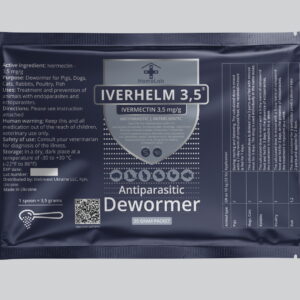
-12% New IvermectinAntiparasitic

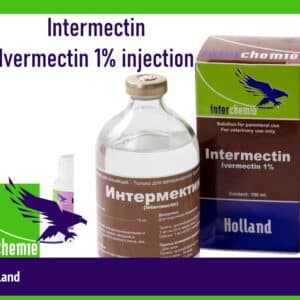
Antiparasitic Promect 1% Solution Ivermectin *inj 100 ml (3.38 oz)
PROMECTINE 1% (Ivermectin) injectable
For the treatment and control of the following species of gastrointestinal roundworms, lungworms, eyeworms, warbles, mites and sucking lice in cattle, sheep, goats, pigs, dogs caused by: cattle: gastrointestinal nematodes – Ostertagia ostertagi, O. lyrata, Trichostrongylus axei, Trichostrongylus columbriformis, Haemonchus placei (including third stage larvae), Nematodirus spp. (mature forms); pulmonary nematodes – Dictyocaulus viviparus (adults and fourth larvae stage); itch tick – Sarcoptes Bovis, Psoroptes bovis; gadfly (in larvae phase) – Hypoderma lineatum, H. Bovis; lice – Linognathus Vitali, Haematopinus eurysternus, Solenopoles capillatus; louse – Bovicola bovis; sheep and goats: gastrointestinal nematodes – Haemonchus contortus, (mature and the third and fourth larvae stage).
-6% New IvermectinAntiparasitic
Antiparasitic 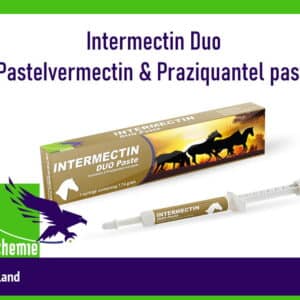
-14% Sold out New IvermectinPraziquantelAntiparasitic
Antiparasitic Intermect Duo Paste for Horses – 7,74g
Intermectin duo paste 7.74 g
Ivermectin & Praziquantel paste
Storage
Disposable polypropylene applicator (syringe). Each syringe contains 7.74 g of a paste containing 120 mg of ivermectin (15.5 mg / g) and 600 mg of praziquantel (77.5 mg / g).
Indication
Intended for the treatment of mixed cestode-nematode and arthropod invasions in horses, namely:
- adult tapeworms: Anoplocephala perfoliate.
- large strongylids: Strongylus vulgaris (adults and larvae in the arterial stage), S. edentatus (adults and larvae in the tissue stage), S. equinus (adults), Triodontophorus spp. (adults) and Craterostomum acuticaudatum (adults).
- adults and immature larvae (intraluminal larvae of the fourth stage) of small strongylids or cyatostom, including strains resistant to benzimidazoles: Coronocyclus, Cyathostomum, Cylicocyclus, Cylicodontophorus, Cylicostephanus, Parapoteriostomom.
- adult hairy individuals: Trichostrongylus axei.
- adults and immature larvae (larvae of the fourth stage) pinworms: Oxyuris equi.
- adults, larvae of the third and fourth stages of nematodes (roundworm): Parascaris equorum.
- microfilariae of cervical nematodes: Onchocerca spp.
- adult intestinal nematels: Strongyloides westeri.
- gastric worms: Habronema muscae.
- oral and gastric stages of larvae of the gnat: Gasterophilus.
- adults and underdeveloped larvae (inhibited larvae of the fourth stage) dictyocaudus: Dictyocaulus arnfieldi.
-14% Sold out New IvermectinPraziquantelAntiparasitic
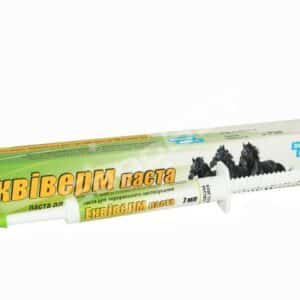
Antiparasitic Equiv Paste for Horses – 7g
Equiverm paste 7 g - Intermectin Duo Paste Analog
Ivermectin & Praziquantel paste
Equiverm paste, syringe 7 ml
Olive green homogeneous paste.
The composition of
1 ml of the drug contains active substances:
ivermectin - 20 mg,
praziquantel - 100 mg.
Excipients: butylhydroxyanisole, sucralose, cinnamon essential oil, colloidal silica, liquid chlorophyll pigment, dimethicone.
Related products
-7% Hot FenbendazoleAntiparasitic
Antiparasitic 
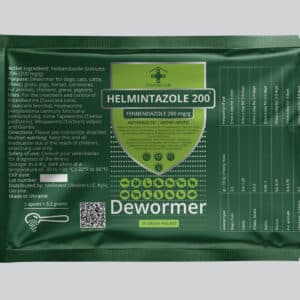
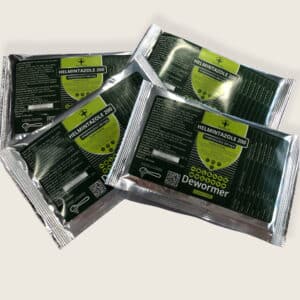
FENBENDAZOLE 200mg Panacur Helmintazole Dewormer powder 100g (0.22 lbs)
Fenbendazole powder (Panacur, Safeguard Canine analog)
Deworming of cattle, horses, sheep, goats, pigs, carnivores, fur-bearing game and poultry infected with nematodes (Mature and immature forms), some types of cestodes, flukes and their eggs.
Controls roundworms, hookworms, whipworms, and Taenia tapeworms
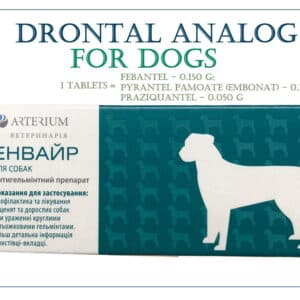
-15% FebantelPraziquantelPyrantelAntiparasitic
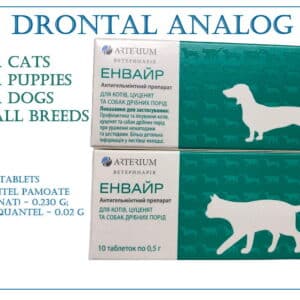
Antiparasitic Envayr Dewormer, Anthelmintic for Dogs 10 Tablets
Envayr for Dogs (Drontal Bayer analog)
Envayr is a broad spectrum tablet to treat tapeworm, roundworm, hookworm and whipworm infections in dogs and puppies that are at least 3 weeks of age and weigh at least 2 lbs. It treats tapeworm infections caused by Dipylidium caninum, Taenia pisiformis and Echinococcus granulosus and treats and controls tapeworm infections caused by Echinococcus multilocularis. It also treats roundworm infections caused by Toxocara canis and Toxascaris leonina, hookworm infections caused by Ancylostoma caninum and Uncinaria stenocephala and whipworm infections caused by Trichuris vulpis.

-14% PiperazineAntiparasitic
Antiparasitic 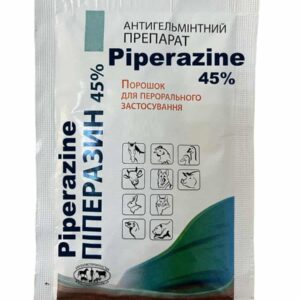
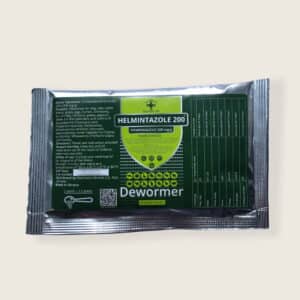
-15% FenbendazoleAntiparasitic
Antiparasitic FENBENDAZOLE 200 mg/g Dewormer for Dogs and Cats 25 g
Fenbendazole powder ● Helmintazole (Panacur, Safeguard Canine analog)
Deworming of cattle, horses, sheep, goats, pigs, carnivores, fur-bearing game and poultry infected with nematodes (Mature and immature forms), some types of cestodes, flukes and their eggs.
Controls roundworms, hookworms, whipworms, and Taenia tapeworms
-18% PiperazineAntiparasitic
Antiparasitic
-11% FenbendazoleAntiparasitic
Antiparasitic 
-10% Sold out AlbendazoleAntiparasitic
Antiparasitic 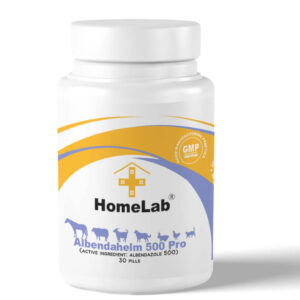
Sold out AlbendazoleAntiparasitic
Antiparasitic Albendahelm 500 Pro Dewormer (30 tablets)
Albendahelm 500 Pro (Albendazole)
Albendahelm 500 Pro (Albendazole) Deworming agent for cattle, sheep, goats, horses, dogs, cats, fur animals, birds.
For the removal and control of liver flukes, tapeworms, stomach worms (including stage 4 inhibited larvae of Ostertagia ostertagi), intestinal worms and lungworms.