Online Pet Vet Pharmacy: Best Deals Up to 40% Off + FREE Shipping on Orders $100+





































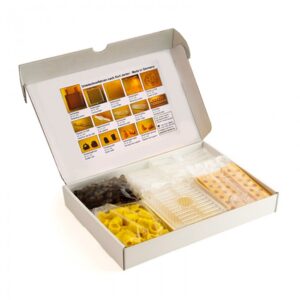
Uterine cell Zander-2
$24.04
Plastic cell to isolate cells of a process of maturation.
| ANIMALS | Bees |
|---|
Customers Also Viewed
Original price was: $55.31.$43.88Current price is: $43.88.
Original price was: $108.90.$101.20Current price is: $101.20.

Original price was: $33.36.$21.88Current price is: $21.88.
Description
Uterine cell Zander-2
Cell Zander-2 consists of a body, two plastic grids on each side (one of which opens) and plug for the hole in the top of the cell.
The principle of insulating cells is quite simple. The top cell is a hole that closes a black cap, a cap has a special slot for bowls. At some point, the already formed bowl queen, grafting is removed from the frame and fixed in a hole located on the plug and then plug from the bowl is placed in the hole insulator Zander-2 queen down.
On the sides are two insulator lattice with holes that allow bees to get full access to the mother liquor to care for him. The holes on the grid are the optimal size, worker bees can easily get to the mother liquor in prison, while the rest uterus is not able to penetrate through the holes of this size.
The uterus is hatched in Tacoma Detention Center, will feel very comfortable, with plenty of space for movement. Get uterine cells will not be difficult, it should only move one side of the cell arrays and you get full access to the uterus.
Delivery
We offer FREE SHIPPING WORLDWIDE for all products.
Questions & Answers
Questions and answers of the customers
Related products
-35% AmipolAmitrazAntiparasiticInsecticidesVarroatosis
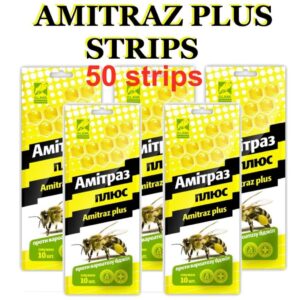
Amitraz Plus Strips Varroa Mite Treatment Honey Bee 50 Strips
Amitraz Strips
Honey bee colony treated in spring (after the first inspection of bee families) in the summer-autumn period (after pumping of honey) by placing preparation strips in beehives 2 strips on 10 – 12 nesting frames. For small bee colony (up to 6 frames) and nucleus boxes enough 1 strips that are placed in the center of the nest. Before using the need to do a hole at one end of the strip, stretch through it and lock pin stripes vertically exactly in the center beehive (in the middle part of it) between two frames of bee nests. In a weak honeybee colony hung one strip between 3 and 4 honeycombs, in strong – one strip between 3 and 4, and the second strip between 7 and 8 honeycombs. Strips leave in a honey-bee colony for a period of 3 to 30 days depending on the size of the brood.

-13% FlumethrinAntiparasiticInsecticidesVarroatosisNew Brand
FLUMETRIY treatment of varroatosis bees Varroa Beekeeper 50 Strips
Flumetriy Strips (flumetrin - 3.85 mg / pl, thymol - 80 mg / pl, juniper essential oil - 30 mg / pl, rosemary essential oil - 25 mg / pl, lavender essential oil - 25 mg / pl.)
Varroatosis treatment: Treatment of bee colonies affected by Varroa destructor mite or tracheal Acarapis woodi mite, Flumet-Roy preparation is carried out in spring, summer, and autumn. Treatment of bee families with the drug "Flumet-Roy" is carried out at the rate of 2 plates per 1 beekeeping force of 10 nest frames, with placement between 3-4 and 7-8 sotoramok, and 1 plate per beekeeping force of 5 nesting frames, with placement in the center of the socket. In case of severe tick damage, 1-2 strips of Flumet-Riy preparation for 10 weeks should be added.
-21% FlumethrinAntiparasiticInsecticidesVarroatosisNew Brand
FLUMETRIY treatment of varroatosis bees Varroa Beekeeper 20 Strips
Flumetriy Strips (flumetrin - 3.85 mg / pl, thymol - 80 mg / pl, juniper essential oil - 30 mg / pl, rosemary essential oil - 25 mg / pl, lavender essential oil - 25 mg / pl.)
Varroatosis treatment: Treatment of bee colonies affected by Varroa destructor mite or tracheal Acarapis woodi mite, Flumet-Roy preparation is carried out in spring, summer, and autumn. Treatment of bee families with the drug "Flumet-Roy" is carried out at the rate of 2 plates per 1 beekeeping force of 10 nest frames, with placement between 3-4 and 7-8 sotoramok, and 1 plate per beekeeping force of 5 nesting frames, with placement in the center of the socket. In case of severe tick damage, 1-2 strips of Flumet-Riy preparation for 10 weeks should be added.
AmitrazAntiparasiticInsecticidesVarroatosis
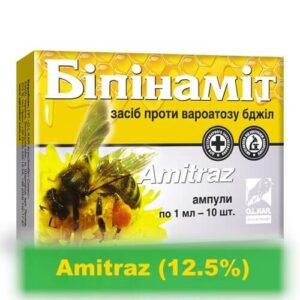
Bipinamite (Amitraz) combat varroatosis (varoosis) of bees (10 amp x 1ml)
Amitraz - Bipinamite
The drug contains amitraz as an active ingredient (12.5%).
Pharmacological properties
Bipinamite has a systemic and contact acaricidal effect against ticks of the genus Varroa.
Bipinamite refers to compounds with moderate toxicity to warm-blooded animals (hazard class III).
The drug does not adversely affect the vital activity of bee colonies and in the recommended concentrations does not affect their general condition, development, and productivity.

-4% AmitrazThymolAntiparasiticInsecticidesVarroatosis